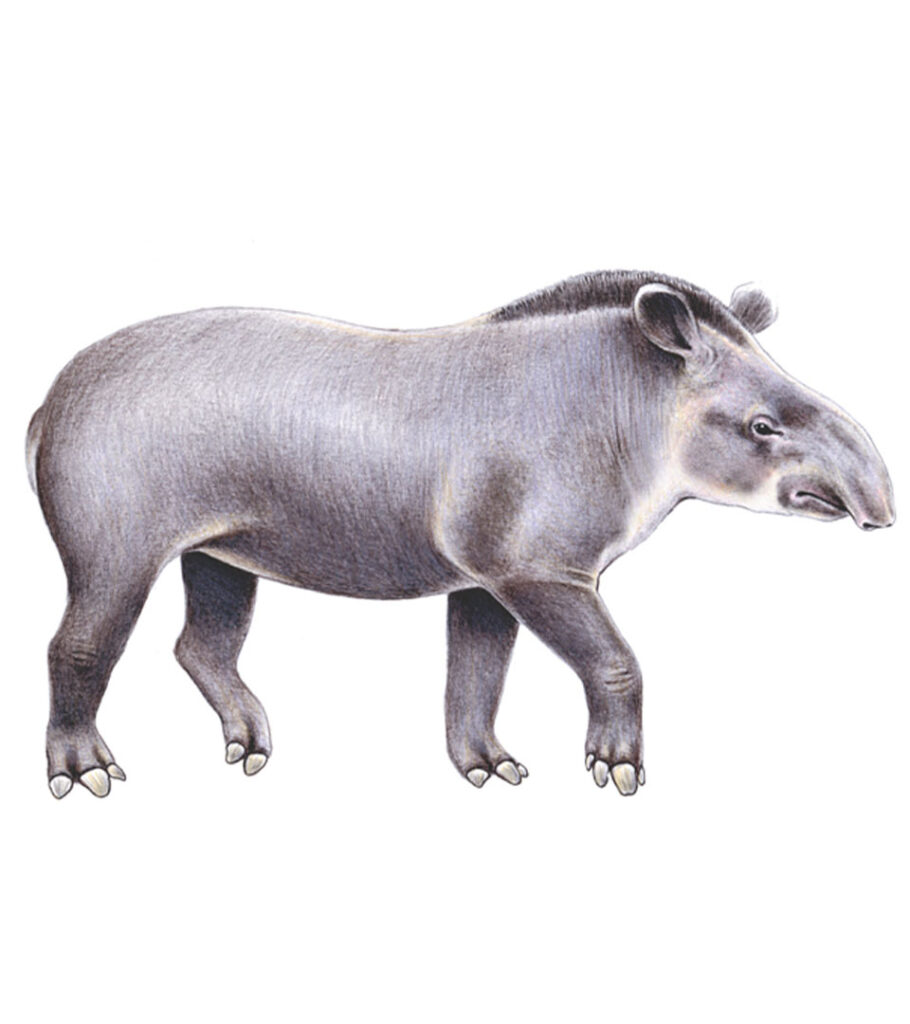
French: Tapir du Brésil; German: Flachlandtapir; Other common names: Brazilian tapir, South American tapir; Portuguese: Anta brasileira, anta sul-americana; Spanish: Tapir amazónico, tapir de tierras bajas.
The lowland tapir (Tapirus terrestris) belongs to the order Perissodactyla and the family Tapiridae. Thuliadanta mayri is the oldest and northernmost record of the tapir lineage, with early Eocene fossils found in the Canadian Arctic (Eberle, ). Biogeographic reconstruction through phylogenetic analysis suggests that tapir evolution occurred at high latitudes with successive migration to lower latitudes (Eberle, ).
The lowland tapir has a wide geographic distribution, occurring in 11 countries and 21 ecoregions. The largest populations occur in the tropical lowland humid and swamp forests of South America, but tapirs also inhabit xeric forests, wooded and wet savannas. Tapirs play an important ecological role as seed dispersers, facilitating gene flow in plant populations, and may be particularly important for dispersing large palm seeds and stimulating plant regeneration in degraded forests by dispersing seeds into tree fall gaps. Lowland tapir dung provides food sources for other animals, including the Atlantic forest squirrel (Guerlinguetus ingrami), which consumes seeds found in tapir dung and dung beetles, which act as secondary seed dispersers.
Species Coordinator: Patrícia Medici, Brazil

English: Baird’s tapir, Central American tapir; Embera: Danda; French: Tapir de Baird; Guna: Moli; Jakalteco: Tzimin; K’iche’: Tucumbalan; Maya: Tzimin; Poqomchi: Tix; q’eqchi’: Tixl; Spanish: Anteburro, Danta, Dante, Danto, Macho de monte, Tapir centroamericano.
The Baird’s tapir (Tapirus bairdii) belongs to the order Perissodactyla, family Tapiridae, and genus Tapirus (although Tapirella is also used for this species. Tapirs appeared about 50 million years ago, and 15 species of tapirs once lived in North America, Europe, and Asia but became extinct due to habitat change, climate change, and hunting. Today, only four tapir species remain, three of which occur in Latin America and the fourth in Southeast Asia. Because extant species show little variation from their ancestors (Ashley et al., ), tapirs are considered “living fossils.”
The distribution of Baird’s tapir extends from northern Colombia through Panama, Costa Rica, Nicaragua, Honduras, Guatemala, Belize, and southeastern Mexico at its northernmost extent. Historically, Baird’s tapirs occurred in El Salvador and Ecuador, but no records have been reported there for decades. Similarly, the species is locally extirpated in some of its range countries, such as Guatemala, where it used to occur.
The Baird’s tapir was listed as vulnerable by the International Union for the Conservation of Nature (IUCN) in 1996 but was subsequently upgraded to endangered in 2002, one of the highest risk categories. This was due to an estimated 50% population decline over a 30-year period. In a review of 4000 mammal species, the Baird’s tapir was ranked 34th in global conservation urgency due to its level of evolutionary distinctiveness and level of threat. It was considered the tenth rarest forest mammal in the Neotropics.
Species Coordinator: Manolo García, Guatemala


English: Andean tapir, mountain tapir, paramo tapir, Roulin’s tapir, woolly tapir; French: tapir des Andes, tapir de Roulin, tapir pinchaque; German: bergtapir, wolltapir; Quechua: sacha huagra; Spanish: danta, danta conga, danta lanuda, danta de monte, danta negra, gran bestia, sacha vaca, tapir, tapir de montaña, tapir Andino.
Mountain tapirs are odd-toed ungulates in the order Perissodactyla, family Tapiridae, and genus Tapirus. While New World tapirs diverged from Asian tapirs 20–30 million years ago, mountain tapirs diverged from their closest relative, the lowland tapir (T. terrestris), only 1.5–7 million years ago. This species has 2n = 76 chromosomes. Based on mitogenomic analysis of mountain tapirs from Colombia, this population experienced a population bottleneck in the last 5000 years.
Mountain tapirs live in South America, in the cloud forests and páramo shrublands and grasslands (high treeless plateaus) of the Andes north of the Huancabamba depression in northern Peru. They are endemic to Colombia, Ecuador, and northwestern Peru, and historically may have lived in western Venezuela. Mountain tapirs are the smallest of the tapirs. Adults have a dark, brown-black, wavy coat that is relatively long and thick, with white fur around the mouth. Mountain tapirs live at high altitudes in the cloud forests and páramo shrublands and grasslands (high treeless plateaus, slopes, and peaks) of the Andes. They are found at altitudes ranging from 1200 to 4800 meters.
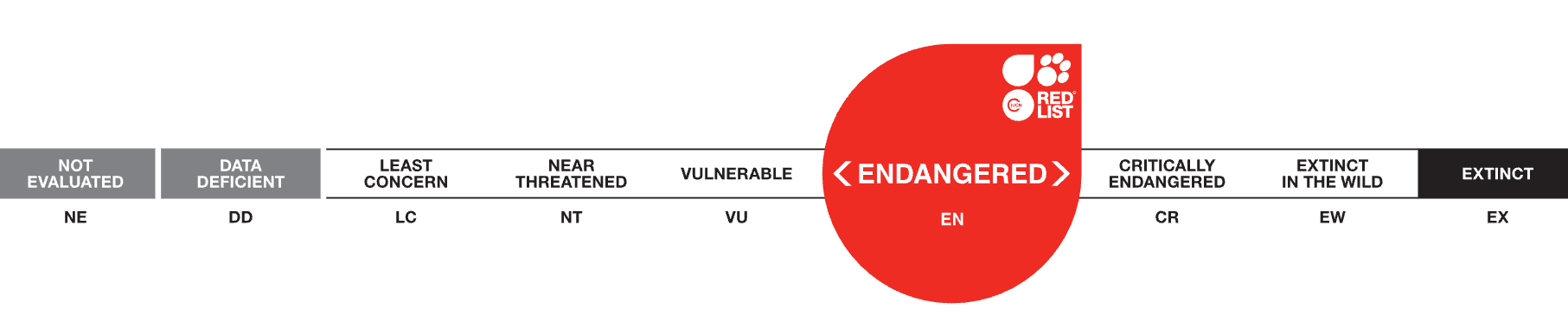
Mountain tapirs are listed as Endangered on the IUCN Red List of Threatened Species and are a CITES I species. There are fewer than 2500 individuals in the three range countries, and mountain tapirs are locally extinct in much of their historic range. In Colombia, mountain tapirs were found in 35 forest regions in 2002, but only 5 or 6 of these had habitats of sufficient size to maintain short-term viable populations of at least 150 individuals.
Species Coordinator: Diego J. Lizcano, Colombia

Danish: Skabarak tapir, Malaj tapir; English: Asian tapir, Asiatic tapir, Indian tapir, Malay tapir; French: Tapir à Chabraque, Tapir à dos blanc, Tapir de l’Inde, Tapir Malais; German: Schabrackentapir; Indonesian: Tapir, tanuk, cipan; Malay: Badak cipan, tenuk, badak murai, badak tampong; Spanish: Tapir de la India.
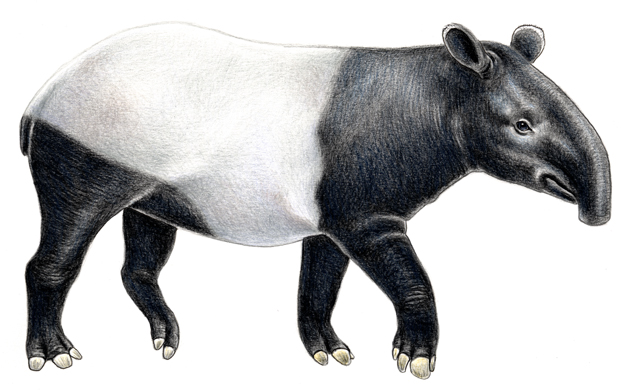
The Malayan tapir, Tapirus indicus, is the only tapir species outside of Latin America. It is also the largest, with a distinctive black-and-white color pattern. For thousands of years, the species was a familiar sight in the tropical rainforests of Thailand, Malaya (peninsular Malaysia), and Sumatra. In 1819, French zoologist Anselme Gaëtan Desmarest was the first European to describe it taxonomically.
The Malayan tapir is currently found in mainland Asia from the tropical regions of Thailand, the Thai isthmus including Myanmar, to the southern tip of peninsular Malaysia. In insular Southeast Asia, it occurs only in Sumatra south of Lake Toba. The Malayan tapir is the only species of tapir that is bicolored. Its black and white coloration clearly distinguishes it from its Latin American relatives. The Malayan tapir is the largest of the four tapir species at birth and grows faster than its relatives, reaching a length of 1.8–2.5 m and a weight of up to 320 kg.
In 2020, the population in Malaysia was estimated to be only 700–800 individuals. This estimate was based on the previous decade’s records of road kills, bycatch in illegally set wire snares, and habitat and population fragmentation. Despite the large increase in the number of new roads, the number of road kills has not increased to the same extent, suggesting that either the population has declined proportionally or density in existing habitat has increased. The latter has not been confirmed by specific density studies in its known habitat, but the number of human–wildlife complaints involving tapirs has increased significantly. Peninsular Malaysia remains the stronghold of the species with an estimated 800–900 individuals.
Species Coordinator: Carl Traeholt, Denmark/Malaysia